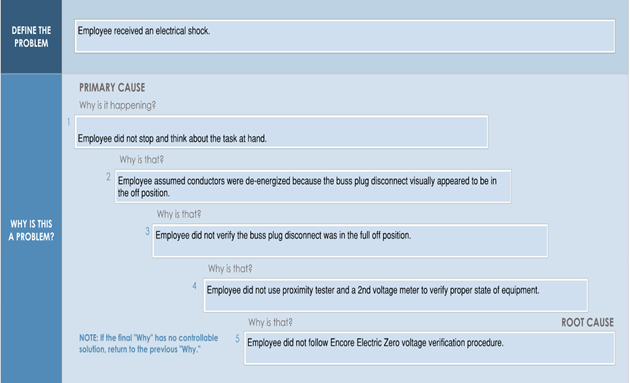

Recently, one of our Encore team members was relocating a disconnect and associated piping for a piece of industrial equipment. The disconnect was fed by a ceiling mounted 480-volt, 3-phase bus plug. The disconnect and piping had been removed, a ¾“ flexible metal conduit, 4 sq-box, and the associated wire remained connected to the bus plug. Inside the ¾” flex and associated J-Box were three current-carrying conductors and one grounding conductor.
Our team member realized that the 3/4” flexible metal conduit was too long and decided to shorten it. He turned off the 480-volt bus plug that fed the J-Box, removed the J-Box’s cover, and began loosening the flex connector. Without checking for the absence of voltage (proximity tester and voltmeter) and without wearing the proper personal protective equipment (leather gloves), the team member removed the wire nuts from the conductors. Our team member then contacted live conductors and suffered a severe electrical shock, including burns on both hands.
Key Lessons Learned
- All Conductors are to be considered energized until proven otherwise.
- Always Test for Absence of Voltage: Even if you believe the power has been turned off and locked out, never assume the circuit is de-energized. Always use a proximity tester and voltmeter to verify.
- Use the Proper PPE: When working with or near electrical systems, wearing appropriate gloves is critical for protection.
- Follow Lockout/Tagout (LOTO) Procedures: Ensure the equipment is completely de-energized and properly locked out, tagged out, and documented before starting any work.
- Due to multiple energized incidents throughout the company, be on the lookout for more communications and direction regarding Zero Voltage Verification.