Annual OSHA Confined Space Refresher Training
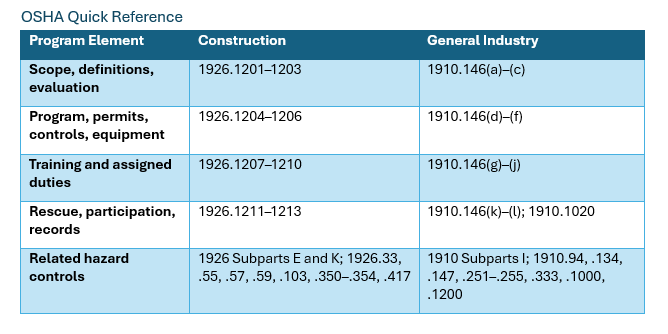
29 CFR 1926 Subpart AA and 29 CFR 1910.146
Purpose: Provide a concise field reference for recognizing confined spaces, controlling hazards, completing safe entry, and responding to changing conditions. This refresher must be used with Encore Electric’s written permit-space program, site-specific hazard assessment, entry permit, and rescue plan.
Recognize and Classify the Space
A confined space is large enough to enter, has limited or restricted entry or exit, and is not designed for continuous occupancy. Examples include tanks, vessels, manholes, utility vaults, pits, sewers, silos, bins, crawl spaces, ducts, and similar enclosed areas.
A permit-required confined space contains or may contain a hazardous atmosphere, engulfment hazard, inwardly converging walls or sloping floors, configuration hazard, or another recognized serious safety or health hazard.
Applicability: Construction work must comply with 29 CFR 1926 Subpart AA. Covered general-industry operations, maintenance, and servicing must comply with 29 CFR 1910.146. Other applicable requirements, including hazardous-energy control, electrical safety, respiratory protection, hot work, PPE, and hazard communication, also apply.
Before work begins: A competent person, coordinated with the Safety Department, must identify and evaluate each space employees may enter. Classification, hazards, testing, controls, entry procedures, communication, and rescue arrangements must be documented before entry. Permit spaces must be identified by signs or another equally effective method, and unauthorized entry must be prevented.
Stop and Ask Before Entry
- Is this a confined space, and is it permit-required?
- What actual or potential hazards are present?
- Has the space been evaluated and the entry authorized?
- Has the atmosphere been tested with a calibrated instrument?
- Have energy sources and material flows been isolated?
- Are ventilation, PPE, access, lighting, barriers, and communication adequate?
- Who are the entrant, attendant, and entry supervisor?
- What is the rescue plan, and is rescue capability available?
Never enter based on past experience alone. Conditions can change.
Permit and Entry Conditions
Before entry, the entry supervisor must authorize a permit identifying the space, purpose, date and duration, entrants, attendant, supervisor, hazards, controls, acceptable conditions, test results, communication methods, required equipment and PPE, rescue service, and any additional permits such as hot-work authorization. The permit must be available at the entry point. Entry ends and the permit is canceled when work is complete or a prohibited condition occurs.
Alternate entry may be used only when physical hazards are eliminated or isolated, the only remaining hazard is atmospheric, forced-air ventilation is sufficient, and supporting monitoring and inspection data are documented. Reclassification is allowed only when all hazards are eliminated and the basis is certified. If a hazard returns, the space returns to permit status.
Control the Hazards
Atmospheric testing: Test with a calibrated direct-reading instrument before entry in this order: oxygen, combustible gases or vapors, then toxic contaminants. Sample representative areas and account for stratification. Monitor continuously where required or as frequently as needed to maintain acceptable conditions.
- Oxygen below 19.5% or above 23.5% is hazardous.
- Flammable gas, vapor, or mist at or above 10% of the lower flammable limit is hazardous.
- Combustible dust at or above its lower flammable limit, or dense enough to obscure vision at about five feet, is hazardous.
- Air contaminants above an OSHA limit or at an immediately dangerous level are hazardous.
If an alarm sounds or readings become unacceptable: STOP WORK AND EXIT.
Isolation: Identify all electrical, mechanical, hydraulic, pneumatic, chemical, thermal, process, and stored-energy hazards. Deenergize, disconnect, block, blank, lock or tag, and verify isolation before entry. Prevent water, chemicals, product, or other material from entering the space.
Ventilation: Purge, flush, inert, or ventilate as required. Ventilation must be suitable for the hazard and must not create another hazard. If ventilation fails, stop entry and reassess.
Equipment: Provide and inspect monitoring instruments, ventilation, communication equipment, PPE, lighting, barriers, safe access, retrieval systems, and rescue equipment. Use equipment according to manufacturer instructions and applicable standards.
Required Personnel and Communication
Authorized entrant: Understands hazards, uses required equipment and PPE, maintains communication, monitors conditions as assigned, alerts the attendant to warning signs, and exits immediately when ordered, alarmed, or endangered.
Attendant: Remains outside, maintains entrant accountability and communication, monitors the space and surrounding activities, prevents unauthorized entry, orders evacuation when needed, summons rescue, and performs no duty that interferes with attendant responsibilities.
Entry supervisor: Verifies the permit, testing, controls, equipment, communication, and rescue capability; confirms acceptable conditions; authorizes entry; removes unauthorized persons; and terminates entry when work is complete or conditions become unsafe.
Communication: Maintain reliable radio, voice, visual, or other approved communication between entrants and the attendant. If communication is lost, stop the entry and follow the site procedure.
Rescue—Plan Before Entry
Never perform an improvised entry rescue. A collapsed entrant may have been overcome by the same unseen hazard that can disable a rescuer.
- Select a rescue service capable of timely response for the identified hazards and space configuration.
- Provide the rescue service with hazard information and access for planning and practice.
- Use non-entry rescue unless retrieval would increase risk or would not aid rescue.
- Provide each entrant a chest or full-body harness and retrieval line connected at an effective retrieval point.
- For vertical spaces more than five feet deep, have a mechanical retrieval device available.
- Designated rescuers must be trained as entrants, equipped, trained in first aid and CPR, and practice representative rescues at least annually.
DO NOT BECOME THE SECOND VICTIM.
Stop-Work Conditions
Immediately stop entry, exit, and reassess when:
- The atmospheric monitor alarms or readings become unacceptable.
- Ventilation fails or isolation is compromised.
- Communication is lost.
- An unexpected hazard develops or conditions differ from the permit.
- Required rescue capability becomes unavailable.
- An entrant shows signs of illness, confusion, weakness, or distress.
- The attendant cannot perform assigned duties.
- Anyone believes the space is unsafe.
When in doubt: EXIT AND REASSESS.
Coordination, Records, and Training
For construction work, the host employer, controlling contractor, and entry employer must exchange known hazards, prior experience, controls, and entry results; coordinate simultaneous work; prevent one employer’s work from creating hazards for another; and complete required post-entry debriefing.
Maintain evaluation, classification, testing, isolation, certification, training, and rescue records required by the applicable standard. Employees and authorized representatives must have access to program documents, permits, certifications, and monitoring results.
Employees must be trained before assignment and retrained when duties, hazards, equipment, procedures, or conditions change; when procedures are not followed; or when an incident, near miss, program review, or observed deficiency shows a need. Training must be understandable, role-specific, and include hazard recognition, permits, testing, ventilation, isolation, communication, PPE, evacuation, and rescue. Proficiency must be verified and training documented.
Crew Discussion
- What hazards could be present in this space?
- Who performs atmospheric testing and verifies acceptable conditions?
- What conditions require immediate evacuation?
- How will entrants and the attendant communicate?
- What is the rescue method, and who will respond?
- Where is the authorized permit located?
Key Takeaway
IDENTIFY → TEST → ISOLATE → CONTROL → COMMUNICATE → MONITOR → RESCUE
Never enter a confined space without proper evaluation, authorization, hazard controls, atmospheric testing, communication, and an appropriate rescue plan. If conditions change, STOP, EXIT, and REASSESS.